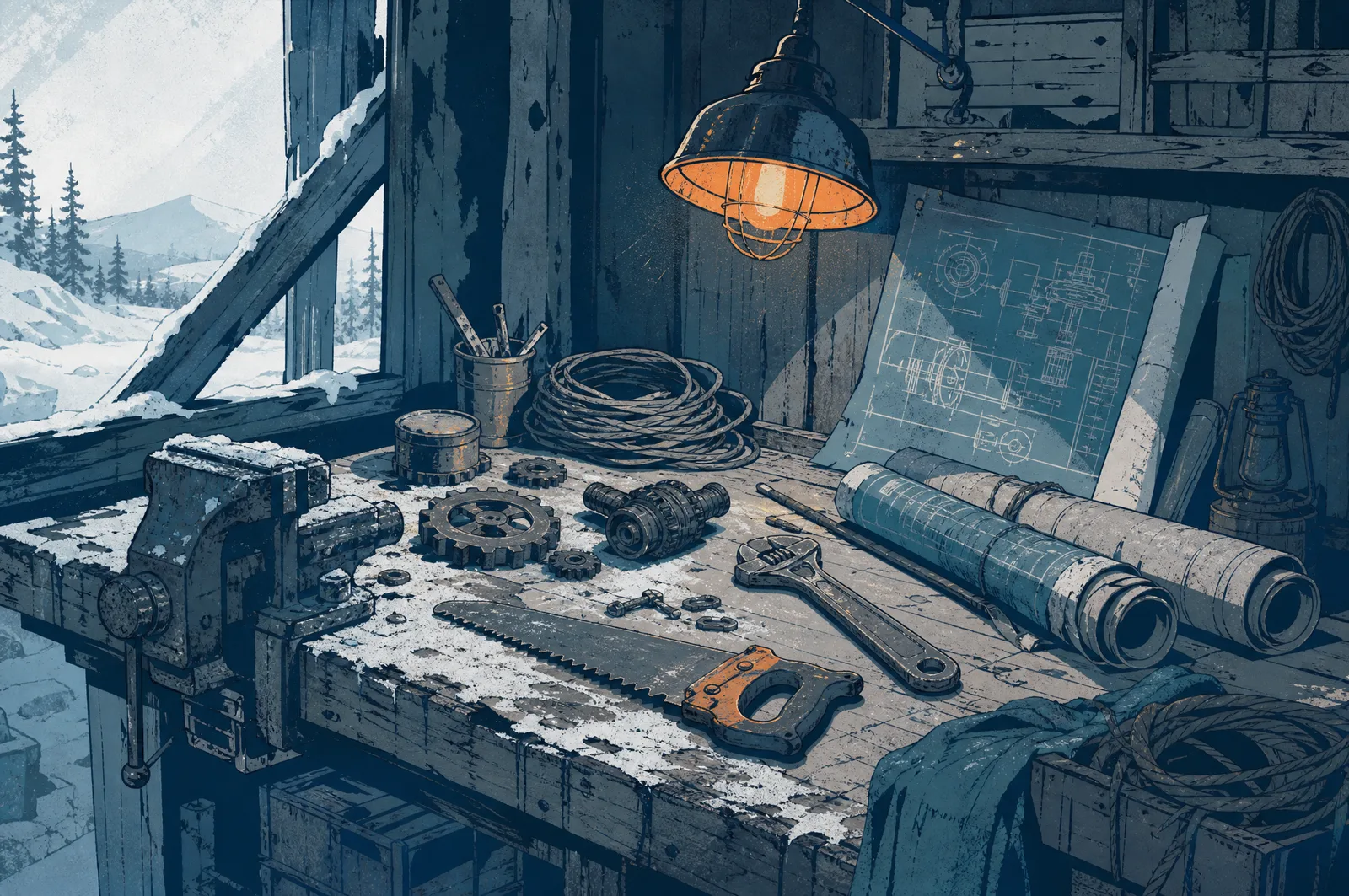
Permafrost crafting is the hinge of the survival loop: you scavenge what the ruined cities left behind, craft it into tools and supplies, and spend the building blueprints on a network of shelters rather than one base. This page covers how those three moves connect, what is worth stockpiling, and where the published information stops.
What crafting is for
The developers describe Permafrost as a story-driven survival sandbox in a frozen post-apocalyptic open world, and they name the loop directly: explore frozen cities and wilderness, survive brutal weather, navigate faction-controlled territories, hunt, scavenge, craft, and build a network of shelters.
Crafting turns the other parts into each other. Scavenging feeds it material, building spends what it produces, and the shelter network is what lets you push further out. You play as a "Rook": an engineer with the skills to rebuild but little wilderness experience. That gap is the point. The character can make things, and the world punishes you while you learn where to make them.
Permafrost building draws on the same scavenged stock as crafting.
What the Early Access build contains
The developer FAQ on the Steam store page states the scope plainly: most planned core features are implemented, several biomes are in, and the build contains hundreds of items along with building blueprints and crafting recipes. The narrative starting point, side quests and four-player co-op are in.
That is scope, not a recipe list.
The loop in one line
Scavenge, craft, build, then repeat further from home. Progression in Permafrost is exploration-gated: you restore abandoned shelters, repair broken machines and reclaim fragile technology to push deeper. Crafting material is what makes those unlocks possible, so route planning and your stockpile are one decision.
Building a first base that holds
- Leave the starting area early. Guide-level advice is blunt that the opening zone is relatively safe, but you run out of food quickly if you stay.
- Scout before you commit. The dog companion is rescued from the ruins and can scout ahead, warn of danger and carry supplies.
- Prefer an abandoned shelter over a site built from nothing. Restoration is an explicit progression path.
- Get warmth running first. Campfires and wall torches are early warmth sources, and in this game a wall torch genuinely provides heat. Keep wood at the base.
- Add crafting and sleeping space in the same shelter. You cannot sleep unless you are adequately warm, so a lit fire near where you sleep is a nightly requirement.
- Expand into a network rather than a second home. The loop asks for a chain of shelters, and co-op does not simplify the world.
- Reclaim technology to open the next stretch. Restoring machines and recovering fragile technology is the reward for surviving further out.
What to stockpile and why
| Stockpile | Why it earns the space | Skipping it costs |
|---|---|---|
| Wood for fire | Sleep requires adequate warmth | No sleep, Energy drains, nights get dangerous |
| Cold-resistant clothing | Warmth drains when temperature is below your clothing's resistance | At zero you take health damage until you warm up |
| Food | Hunger at zero applies negative effects | Effects stack while you are still learning the map |
| Repair and build material | Shelter restoration and machine repair consume it | Progression stalls at the edge of cleared ground |
| Heat and light further out | The loop wants a network, not one base | Routes have no safe midpoint to sleep at |
Where the public information stops
Specific recipe lists, material costs and blueprint names are Unconfirmed (verify in-game). No official recipe table has been published, and the sources this site is built from contain none. This page therefore describes what the system does, and stops there on purpose.
Two notes are worth carrying into the crafting screen. Effects are buffs and debuffs at the top left of the Inventory screen, and hovering over a debuff tells you what removes it. The developers also call the cold your true enemy, so anything that produces heat earns its slot.
What to read next
- Survival Basics for the stats that crafting is trying to protect.
- Map and Locations for where the material is and when to turn back.
- Multiplayer and Co-op for how a shared shelter network changes the plan.
- Tips for short habits that keep a base running.
Sources
- Permafrost on Steam: Early Access scope, store features and the developer FAQ.
- Permafrost beginner guide (TechRaptor): guide-level advice on warmth, sleep, stats and Effects.
- Toplitz Productions game page: publisher page for the game.